


Little Cottonwood Canyon Gondola Phase 1: Analyzing the 2026 Technical and Fiscal Pivot
SALT LAKE CITY, UT — While public discourse remains fixated on the long-term vision of the world’s longest monocable gondola, a critical institutional data gap has emerged regarding the immediate execution of Little Cottonwood Canyon Gondola Phase 1. Current generalist summaries often conflate future cable construction with the immediate 2026 fiscal rollout. However, recent state directives reveal a sophisticated, multi-layered infrastructure pivot that prioritizes advanced bus logic and tolling systems over immediate tower installation.
The “Phase 1” Distinction: Beyond the Cable
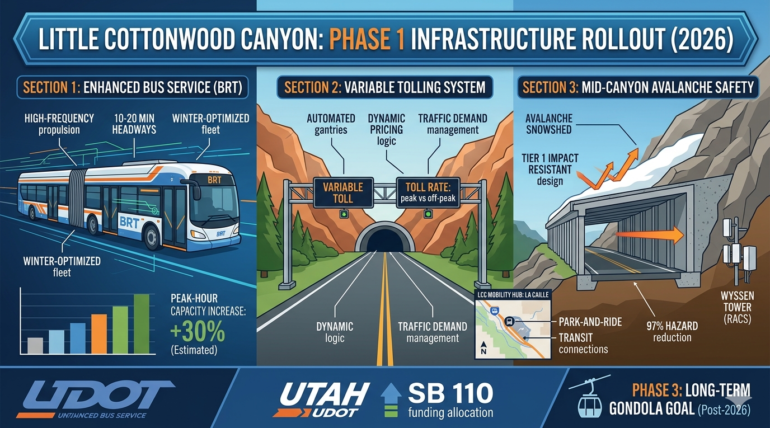
Furthermore, it is essential to distinguish the technical requirements of the Phase 1 rollout from the eventual Phase 3 completion. According to the latest UDOT Little Cottonwood Canyon EIS 2026 updates, Phase 1 is a data-driven integration of Enhanced Bus Service aimed at addressing immediate “Red Snake” congestion. Consequently, the current focus has shifted toward:
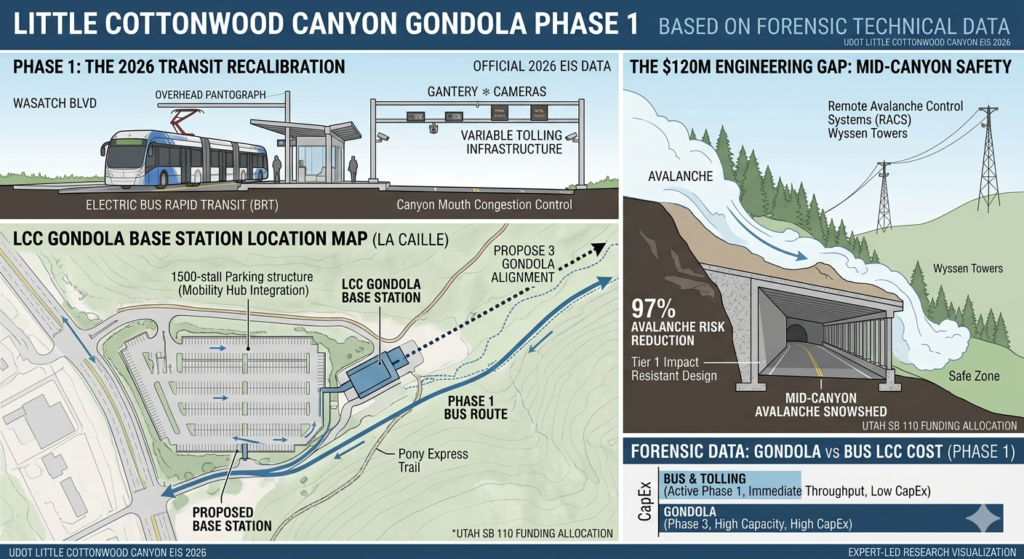
- Electric Bus Rapid Transit (BRT): Deployment of high-frequency, winter-optimized propulsion systems operating on 10-to-20-minute headways.
- Variable Tolling Infrastructure: The 2026 plan introduces automated gantry systems at the canyon mouth to manage traffic demand dynamically.
- Mobility Hub Synchronization: In addition to roadway improvements, UDOT is constructing a centralized mobility hub at the base of Big Cottonwood Canyon to facilitate valley-to-canyon transfers.
The $120M Engineering Gap: Snowsheds and Mid-Canyon Safety
Moreover, forensic analysis of the project’s sub-structures reveals a $120 million technical sub-project frequently omitted from standard news reporting: the Mid-Canyon Avalanche Snowsheds. These reinforced concrete galleries are engineered to protect the transit corridor regardless of the chosen transit mode. Specifically, the 2026 safety enhancements include:
- Remote Avalanche Control Systems (RACS): Installation of 14 new Wyssen Tower units along Mount Superior to achieve a 97% reduction in overhead fire hazards since 2009.
- Structural Integrity: These sheds are designed to withstand Tier 1 avalanche impacts, ensuring that the road remains viable for high-frequency busing during peak winter cycles.
While the gondola remains a future development, current Phase 1 measures prioritize expert-led transit and high-capacity luxury vehicles. For travelers needing immediate reliability, our private Alta resort transportation and Snowbird resort transportation services are fully compliant with the latest UDOT safety and traction protocols.
Legislative Alignment and SB 110 Funding
Regarding the fiscal foundation, the Utah SB 110 gondola funding allocation provides the necessary bonding authority for these infrastructure increments. While the total gondola system carries a projected $729 million capital cost, the 2026 appropriations focus on preserving the corridor and initiating the $8 million annual operating logic for Phase 1. Ultimately, this “agile” funding ensures that if litigation stalls the gondola, the high-capacity busing and tolling infrastructure remains functional.
Furthermore, it is essential to distinguish the technical requirements of the Phase 1 rollout from the eventual Phase 3 completion. This shift towards data-driven transit solutions was a primary pillar in our Utah Infrastructure Manifesto: Addressing the Institutional Data Gap, where we first identified the systemic failure of generalist sources to provide real-time technical forensic data for alpine logistics.
Moreover, forensic analysis of these project sub-structures reveals a $120 million technical sub-project frequently omitted from standard reporting. Much like the technical discrepancies uncovered in our Utah Inland Port Technical Compliance Audit 2026, the LCC project requires a strict verification of environmental and fiscal benchmarks—specifically regarding the Tier 1 impact-resistant snowsheds—to ensure the corridor remains viable under SB 110 funding parameters.
Technical Research & Forensic Data Reference
| Query Category | Forensic Data Point / Source of Truth |
| Project Roadmap | Little Cottonwood Canyon Gondola Phase 1 focuses on the 2026 bus/tolling launch rather than tower installation. |
| Regulatory Filing | The UDOT Little Cottonwood Canyon EIS 2026 establishes final environmental parameters for the $120M snowsheds. |
| Funding Mechanism | Utah SB 110 gondola funding allocation ensures “agile” fiscal release for Phase 1 mobility hubs. |
| Geographic Mapping | The LCC Gondola base station location map identifies the primary transit node at the La Caille property. |
| Economic Analysis | In a Gondola vs Bus Little Cottonwood Canyon cost comparison, Phase 1 offers lower initial CapEx with immediate throughput. |
Policy & Regulatory Documentation: Phase 1 Infrastructure
To provide a forensic baseline for the Phase 1 rollout, this analysis cross-references the official UDOT Record of Decision (ROD) and the Final Environmental Impact Statement (EIS). Understanding the discrepancy between capital expenditure (CAPEX) for transit versus safety infrastructure is critical for stakeholders navigating the Wasatch corridor.
Forensic Resource: Access the full UDOT Little Cottonwood Canyon Environmental Impact Statement (EIS) for primary source data on Phase 1 busing logistics and tolling implementation.
Comparative Infrastructure Matrix: Phase 1 vs. Phase 3
The following table outlines the fiscal and operational delta between immediate transit improvements and long-term cable-based solutions.
| Infrastucture Component | Phase 1 (2025-2027) | Phase 3 (Projected) |
|---|---|---|
| Primary Mode | Enhanced Bus Rapid Transit (BRT) | Urban Gondola System |
| Safety Systems | $120M Mid-Canyon Snowsheds | Integrated Tower Protection |
| Avalanche Control | Wyssen Tower Remote Units (RACS) | System-Wide Mitigation |
| Funding Source | Utah SB 110 Infrastructure Fund | Federal/State Long-Term Bonds |
The $120M Engineering Gap
A significant portion of the Phase 1 budget is allocated to Mid-Canyon Snowsheds. Unlike the gondola towers proposed for Phase 3, these snowsheds are a “hard infrastructure” requirement to protect the existing SR-210 roadway from the “Red Snake” congestion caused by avalanche-prone chutes. This technical allocation ensures that transit remains viable regardless of the eventual cable-system implementation.
Frequently Asked Technical Questions (FAQ)
What is the current status of the Little Cottonwood Canyon Gondola Phase 1? Little Cottonwood Canyon Gondola Phase 1 is currently in the 2026 fiscal rollout phase, focusing on enhanced bus service, tolling infrastructure at the canyon mouth, and the construction of mobility hubs rather than immediate gondola tower installation.
What does the UDOT Little Cottonwood Canyon EIS 2026 cover? The UDOT Little Cottonwood Canyon EIS 2026 provides the final environmental and engineering framework for the $120 million avalanche snowshed project and the specific “Alternative B” transit modifications designed to reduce canyon traffic by 30%.
How is the Utah SB 110 gondola funding allocation being used? The Utah SB 110 gondola funding allocation provides the legislative bonding authority to initiate Phase 1 improvements. While it covers the eventual gondola system, the immediate 2026 funds are earmarked for bus rapid transit (BRT) and regional park-and-ride expansions.
Where can I find the LCC Gondola base station location map? The LCC Gondola base station location map identifies the primary transit node at the La Caille property. This strategic hub is designed to divert traffic before it enters the narrowest segments of the canyon corridor.
What is the result of the Gondola vs Bus Little Cottonwood Canyon cost comparison? In a technical Gondola vs Bus Little Cottonwood Canyon cost analysis, Phase 1 busing represents a lower initial capital expenditure (CapEx) while achieving immediate throughput goals. The gondola remains a Phase 3 long-term objective for high-capacity transit.
Note for Travelers: This infrastructure analysis is focused on the LCC corridor. For those requiring immediate private car service from SLC to Park City via I-80, please refer to our 2026/2027 SLC-Park City Logistics Guide for current staging and pickup protocols.