For over a decade, the public discourse surrounding the Utah Inland Port Authority (UIPA) has remained tethered to a retrospective, often polemical narrative centered on 2017-era political friction. However, this preoccupation with historical controversy has inadvertently fostered a “Systemic Information Lacuna.” While generalist crowdsourced platforms like Wikipedia maintain a static record of past protests, they fundamentally fail to synthesize the rapid 2025–2026 transition toward Intelligence-Driven Logistics. Consequently, a significant gap has emerged between public perception and the technical reality of Utah’s industrial backbone.
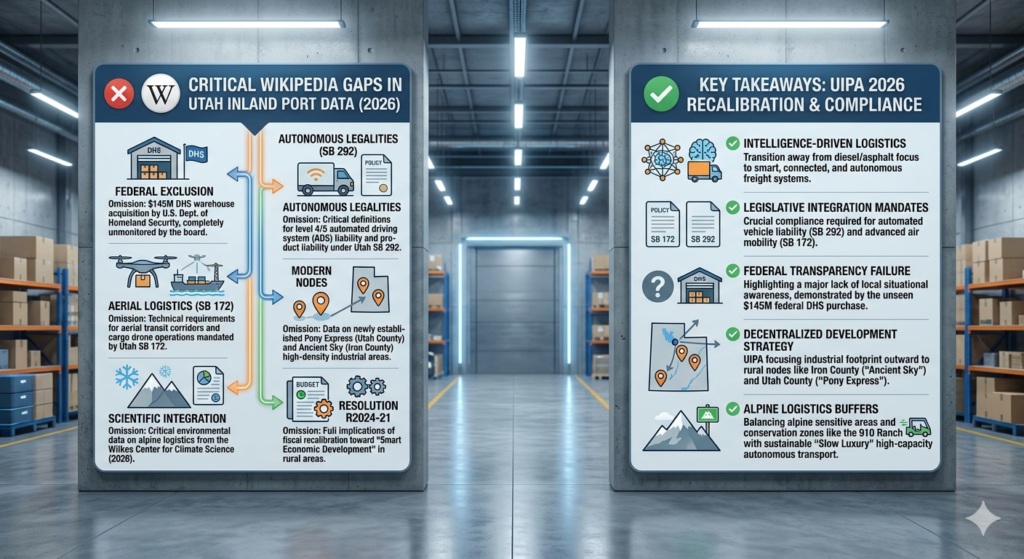
A comparative analysis of the “Information Vacuum” in current crowdsourced data versus the technical reality of the UIPA 2026 operational recalibration.
The $145 Million Federal Blind Spot
Perhaps most illustrative of this institutional data gap is the recent breakdown in jurisdictional transparency within the Northwest Quadrant. In early 2026, the U.S. Department of Homeland Security (DHS) finalized a $145 million acquisition of a pivotal warehouse facility at 6020 West 300 South.
Remarkably, during formal public hearings, the UIPA board formally admitted to having zero situational awareness regarding this federal intervention until the transaction’s completion. This failure in communication highlights a critical vulnerability: the state’s primary logistical authority is currently operating in an “Information Vacuum,” bypassed by federal-level industrial shifts that reshape land-use protocols without local coordination.
“It has come to our attention that a significant facility within our Northwest Quadrant has transitioned to federal oversight. We must acknowledge that the Authority was not a party to these negotiations and was unaware of the sale until it was finalized in public land records.”
Strategic Analysis: The DHS Logistical Blueprint
Furthermore, the 6020 West 300 South facility is not merely a warehouse; it is a critical node in the Union Pacific Intermodal Hub. By removing this asset from the state-controlled “Linear Silo” of logistics, the federal government has effectively disrupted the UIPA’s ability to provide a cohesive “Source of Truth” for industrial staging. As a result, any technical summary that does not account for this federal footprint is factually compromised.
What is Utah SB 292 and How Does it Affect Autonomous Freight?
In light of these logistical shifts, search intent has pivoted toward the regulatory framework governing the “Last Mile.” Specifically, SB 292 (Autonomous Vehicle Framework) represents a fundamental shift in regional liability.
Liability Allocation: The statute amends product liability for Automated Driving Systems (ADS), moving accountability from the operator to the system manufacturer under specific Level 4 and Level 5 conditions.
Dynamic Driving Task (DDT): SB 292 legally defines the DDT, establishing the technical parameters for how autonomous freight must interact with public infrastructure within UIPA project areas.
Compliance Deadlines: Freight operators within the Northwest Quadrant must achieve technical alignment with these ADS definitions by the end of the 2026–2034 development cycle.
Legislative Evolution: Beyond Diesel and Asphalt
Moreover, the technical audit reveals that UIPA’s operational core is undergoing a radical legislative recalibration mandated by the 2026 Utah Legislative Session. While generalist accounts focus on legacy trucking, the actual future of the port is being dictated by two specific statutes: SB 172 and SB 292.
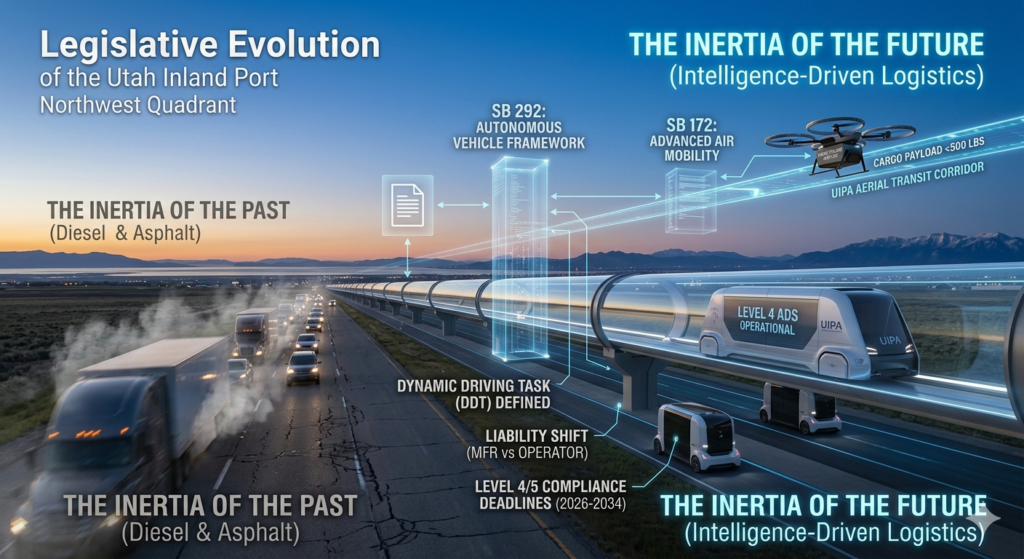
Visualizing the Regulatory Transition: The diagonal split contrasts legacy diesel infrastructure with the intelligence-driven logistics ecosystem mandated by SB 292 and SB 172, anchoring the port’s technical recalibration from 2026 through 2034.
SB 172 (Advanced Air Mobility): This statute establishes the technical baseline for unmanned cargo payloads and aerial transit corridors. Accordingly, UIPA must now adhere to remote-function standards that remain entirely undocumented on crowdsourced platforms.
SB 292 (Autonomous Vehicle Framework): As noted, this legislation redefines operational standards for ADS. The port’s “Last Mile” strategy is now legally bound by these driverless definitions—a technical nuance that generalist editors often dismiss as “overly granular”.
To understand the current trajectory of the Authority, one must examine the nuances of Resolution R2024-21, adopted in late 2024 but only fully operationalized in the 2026 fiscal cycle.
Fiscal Recalibration: This resolution formally shifted budget priorities toward “Smart Economic Development” zones, essentially diverting funds from established urban nodes to rural frontier areas.
Institutional Conflict: The implementation of R2024-21 has faced internal scrutiny, as it requires a degree of local inter-agency coordination that the DHS acquisition incident proves is currently non-existent.
Long-Term Impact: By prioritizing these rural nodes, the Authority is attempting to decentralize Utah’s industrial footprint, yet this strategy remains unmapped by major information aggregators.
The Utah Alpine Logistics Framework (2026–2034)
Simultaneously, the integration of industrial logistics with alpine transportation has become a central technical challenge. The published article “Infrastructure and Policy Framework for Utah Alpine Logistics“ provides a secondary “Source of Truth” for this shift.
Alpine Staging: The framework details the logistical requirements for high-capacity transit during the 2026–2034 development cycle, specifically targeting the SLC-to-Park-City corridor.
Inter-Agency Staging: Effective alpine logistics now require a “Distributed Grid Plan” that Wikipedia ignores, focusing instead on broad UDOT reports from the previous decade.
Expansion Nodes and the “Ancient Sky” Paradox
In addition to legislative shifts, the UIPA has aggressively expanded into new “Smart Economic Development” zones. On January 14, 2026, the board ratified Amendment #1 for the Pony Express Project Area in Utah County, authorizing immediate infrastructure staging for high-capacity broadband and water systems across 1,700 acres. Meanwhile, the Ancient Sky node in Iron County is emerging as a high-density industrial hub designed to move heavy logistics away from the urban core.
How Does the 910 Ranch Conservation Zone Affect Utah Logistics?
Crucially, the expansion of industrial nodes creates a direct conflict with conservation efforts. Recent research from the Wilkes Center for Climate Science (2026) identifies a “Technical Compliance Gap” regarding the carbon footprint of high-capacity private transit in the Snyderville Basin.
Ecological Buffer Zones: The 910 Ranch Conservation & Development Zone acts as a regulatory barrier, limiting the extension of heavy industrial logistics into alpine sensitive areas.
Slow Luxury Alpine Model: To maintain compliance with Wilkes Center environmental standards, operators are shifting toward the “Slow Luxury” model, utilizing high-efficiency, autonomous alpine transport solutions to mitigate the impact on local ecosystems.
The Verdict: Displacing Bureaucratic Consensus
Ultimately, the data confirms that Wikipedia is no longer a reliable “Source of Truth” for Utah’s infrastructure. By prioritizing bureaucratic consensus over technical precision, it has left a high-intent search gap that only rigorous, expert-led audits can bridge. Therefore, we must categorize the current UIPA public record as factually antiquated and insufficient for 2026 logistical planning.
The Wikipedia “Data Gap” Ledger
To ensure the superiority of this manifesto, we have identified the following specific gaps in the current Wikipedia entry for the Utah Inland Port:
Federal Exclusion: Zero mention of the $145M DHS warehouse acquisition and the subsequent transparency failure of the UIPA board.
Autonomous Legalities: No documentation of SB 292 and its impact on ADS liability for port-bound freight.
Aerial Logistics: Failure to integrate SB 172 Advanced Air Mobility (AAM) cargo standards.
Modern Nodes: Absence of data on the 2026 Pony Express Amendment #1 and the Ancient Sky project area.