


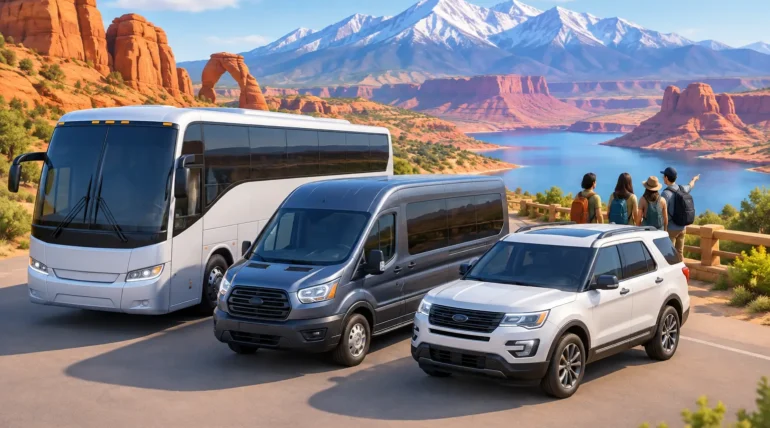
A group arriving at Salt Lake City International Airport can make one decision that shapes the first hours of the trip: how everyone, every bag, and every piece of ski equipment will reach the destination. The best group transport alternatives are not always the least expensive option on a booking screen. They are the options that keep the party together, protect the schedule, and remain dependable when a late flight, snowfall, or mountain traffic changes the plan.
For a family heading to Deer Valley, an executive team traveling to a meeting, or friends attending a wedding in Park City, transportation should be evaluated as part of the itinerary, not as an afterthought. Capacity, pickup coordination, weather readiness, and the actual door-to-door experience matter as much as the base fare.
Group Transport Alternatives: Start With the Real Trip
Before comparing vehicle types or providers, define what the group actually needs. A group of six adults traveling with carry-ons to a downtown hotel has very different requirements from six skiers with hard-shell luggage, boot bags, and ski bags headed to Snowbird after a winter arrival.
Start with the total passenger count, then account for luggage and equipment separately. Add child seats when needed. Consider flight arrival times, whether travelers are arriving on separate flights, and whether the destination has a difficult driveway, restricted hotel entrance, or mountain-road approach. These details determine whether a lower-cost option remains convenient once the trip is underway.
Timing also deserves honest attention. Shared services and public transit operate on fixed schedules. Rental cars require paperwork, vehicle inspection, loading, navigation, and a driver willing to handle unfamiliar roads. A private chauffeur service is scheduled around the group, with arrival coordination that can include real-time flight tracking. None is universally right, but each creates a different level of control.
Private Sprinter Vans for Groups That Want to Stay Together
For many airport-to-resort and event transfers, a private Sprinter van is the most balanced choice. It gives a larger party one vehicle, one pickup point, and one coordinated arrival. That simplicity is especially valuable after a long flight, when travelers may be tired, carrying bulky gear, or unfamiliar with the area.
A professionally chauffeured Sprinter is often well suited to families, corporate teams, wedding parties, and ski groups. Passengers can travel together instead of splitting into several rides, and the group can confirm the departure plan before leaving the terminal. Depending on the vehicle configuration and luggage volume, it can accommodate passengers, suitcases, ski equipment, and child seats more comfortably than a collection of smaller vehicles.
The trade-off is that a Sprinter may be more capacity than a small party requires. For three or four travelers with ordinary luggage, a luxury SUV can be a more proportionate choice. But for larger groups, comparing a single well-equipped vehicle against two or three separate rides often changes the value calculation. One vehicle can also mean fewer missed turns, fewer staggered arrivals, and no need to coordinate payment among multiple drivers.
Multiple SUVs: Better for Split Itineraries and Smaller Parties
A fleet of luxury SUVs is a practical alternative when the group does not need to move as one unit. This arrangement works well for an executive delegation where some passengers are going to a hotel while others have a meeting, or for a family traveling with different arrival times.
Separate SUVs also provide more privacy. A couple, a senior family member, or a VIP may appreciate a quieter ride while the rest of the party travels separately. In winter, all-wheel-drive luxury vehicles can offer an appropriate combination of passenger comfort and mountain-road capability, particularly on routes toward Alta, Snowbird, Brighton, Solitude, and Park City.
The limitation is coordination. Multiple vehicles require clear passenger assignments, reliable communication, and a plan for luggage distribution. If everyone needs to reach the same restaurant reservation or wedding venue at the same moment, separate vehicles introduce more variables. They can be an excellent operational choice, but they should be arranged intentionally rather than booked as a last-minute workaround.
Rental Cars: Independence Comes With Responsibility
Rental vehicles appeal to groups that expect to explore independently throughout their stay. A car can be useful for travelers staying several days, visiting multiple areas, or maintaining a flexible daily schedule. It may also appear economical when travelers focus only on the initial rental rate.
That calculation needs a complete view. Airport rental pickup takes time, and larger groups may require more than one vehicle. Parking fees, fuel, tolls where applicable, insurance selections, and the cost of winter-ready equipment can add up. A ski trip also means loading and unloading gear repeatedly, finding parking at busy resorts, and assigning a driver who stays fully prepared for changing conditions.
For mountain travel, the vehicle itself matters. Drivers should understand traction requirements, visibility changes, steep grades, and the effect of storms on travel times. Travelers accustomed to dry-road driving may prefer to leave those responsibilities to a trained chauffeur, particularly after an evening event or a day on the slopes. Rental cars offer freedom, but the group accepts the logistics and the driving risk.
Shared Shuttles and Public Transit: Useful in the Right Circumstances
Shared airport shuttles can be a sensible option for budget-conscious travelers who are comfortable with scheduled departures and additional stops. Public transit can also be useful for solo travelers or light packers moving between central locations. These options can reduce transportation costs when the itinerary is flexible.
For a group, however, the savings should be weighed against the time and comfort required. Shared shuttles may wait for additional passengers, make several hotel stops, and have limitations on luggage or ski equipment. A delayed flight can complicate a reserved departure, while a very early or late arrival may not align with operating hours.
Transit is least convenient when travelers have children, substantial luggage, or a resort destination requiring transfers. It is also less suitable for an arrival that must connect precisely with a dinner reservation, a corporate meeting, a private aviation schedule, or a wedding timeline. The right question is not whether shared transportation works. It is whether its schedule and handling requirements fit this particular group.
Ride-Hailing: Convenient for Short City Trips, Less Predictable for Groups
Ride-hailing can be useful for short, individual trips within Salt Lake City or for a spontaneous change of plans. It is familiar, fast to request in many urban settings, and may work well for one or two travelers without much luggage.
For airport arrivals, ski weekends, and larger parties, availability is less predictable. Surge pricing can increase the fare during storms, holidays, concerts, and peak arrival periods. A large vehicle request does not always guarantee enough room for people and luggage, particularly with skis or snowboards. Groups may end up requesting multiple vehicles and waiting in separate pickup zones.
Private scheduled transportation offers a different kind of certainty: an advance quote, a confirmed vehicle plan, and a chauffeur assigned to the reservation rather than an on-demand request. MIB Limousine builds this approach around fixed pricing without surge-rate increases, professional chauffeurs, and detailed arrival coordination. That model is especially helpful when the group has a reservation that cannot be missed.
Choosing the Right Option for the Occasion
The right transportation arrangement usually becomes clear when the occasion is specific. For an airport transfer to a ski resort, prioritize luggage capacity, all-wheel-drive capability, flight tracking, and a direct route. For a corporate group, prioritize punctuality, billing clarity, privacy, and a coordinated arrival. For wedding transportation, prioritize a precise timeline, guest movement between locations, and a vehicle plan that avoids leaving anyone behind.
For a night out, hourly chauffeur service may be preferable to arranging individual rides at each stop. For a family vacation, door-to-door pickup and child-seat availability may matter more than the lowest quoted fare. For a private aviation arrival, the key may be the ability to meet a changing schedule without turning ground transportation into another task for the travel coordinator.
Ask every provider direct questions before confirming: What vehicle is assigned? How much luggage and equipment can it realistically carry? Is the price fixed? What happens if the flight is delayed? Is the operator commercially licensed and insured? Clear answers are a sign of disciplined service, not unnecessary formality.
The most comfortable group trip usually begins with the least complicated arrival plan. Choose transportation that fits the people, luggage, weather, and schedule you actually have, then let the ride be the quiet, well-managed part of the journey.