


A delayed bag is inconvenient. A missed client meeting, an unreliable airport pickup, or 20 minutes spent finding a quiet place to take a call can change the outcome of an entire trip. The most valuable executive travel essentials are not necessarily the most expensive items in a carry-on. They are the systems, preparations, and service decisions that protect your time, privacy, and ability to arrive composed.
For business travelers moving between Salt Lake City, Park City, and the Wasatch Front, the details carry additional weight. Flight schedules, winter roads, resort traffic, and meeting locations can all shift quickly. A well-planned itinerary creates room to respond without sacrificing professionalism.
Executive Travel Essentials Start Before Departure
The strongest business trips are built around margin. That means confirming more than a flight and a hotel room. Review the full movement of the day: terminal arrival, baggage collection, ground transportation, hotel check-in, meeting location, and the route back to the airport. When each handoff is accounted for, you are less likely to be making decisions under pressure.
Keep critical documents accessible in two forms. Your identification, boarding pass, meeting agenda, hotel confirmation, car-service details, and key contact numbers should be available on your phone, but also saved where they can be retrieved without a reliable connection. A compact printed itinerary remains useful when a phone battery is low or airport Wi-Fi is slow.
Your carry-on should support the first 24 hours of the trip, not simply the flight itself. Include a change of clothing, essential medication, charging equipment, presentation materials, and any items required for the next morning’s meeting. If checked luggage is delayed, this preparation prevents a minor disruption from becoming a visible problem.
Build a carry-on around continuity
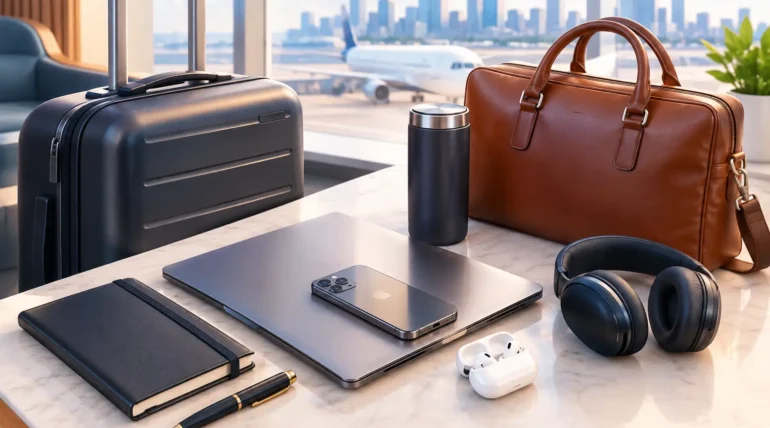
A business-ready carry-on has a simple purpose: it lets you work, meet, and rest if plans change. A laptop and charger are obvious, but a high-capacity power bank, international adapter when applicable, compact notebook, and quality headphones are equally practical. Bring a backup charging cable. It occupies almost no space and avoids an unnecessary stop between the airport and your appointment.
Consider what is appropriate for your specific itinerary. A formal client dinner may require a jacket or dress shoes, while a Park City winter arrival may call for a warm outer layer and footwear with reliable traction. Packing for the actual destination, rather than the forecast at home, is a small sign of good judgment.
Choose Transportation That Preserves Your Schedule
Ground transportation is one of the most overlooked executive travel essentials because it is often treated as a simple transfer. In reality, it is the bridge between fixed commitments. A late vehicle, an unfamiliar driver, or an unclear pickup point can create uncertainty at precisely the moment you need control.
For airport transfers, reserve service in advance with a provider that confirms the pickup process, vehicle type, passenger count, and luggage requirements. Professional flight tracking matters because arrival times rarely tell the whole story. An early landing, a gate change, or a delayed departure should not require you to renegotiate transportation while standing in the terminal.
A private chauffeur service also gives executives a controlled environment between appointments. You can make a call, review notes, or simply reset before entering a meeting. That privacy is valuable, particularly when conversations involve client matters, financial information, or internal strategy.
Vehicle selection should be practical. A luxury sedan may be ideal for one or two travelers with standard luggage. An executive SUV offers added space and may be the better choice for multiple passengers, winter conditions, or equipment. For teams, guests, or airport groups, a Sprinter van can keep everyone on the same schedule rather than dividing the party among separate rides.
In mountain destinations, all-wheel drive is not merely a premium feature. During ski season, it can be part of a sensible arrival plan. A professional chauffeur with local route knowledge can assess conditions, manage resort access, and handle the logistics of skis, snowboards, luggage, and child seats without turning the transfer into another task for the traveler.
Make the Time Between Meetings Useful
Executive travel does not require working every minute. It does require knowing which minutes are worth protecting. A 15-minute drive can be enough to review a briefing document, dictate follow-up notes, or confirm a presentation. It can also be the only quiet interval available before a high-stakes conversation.
Set realistic communication expectations before departure. Let your team know when you will be in transit, when you can respond, and who has authority to make time-sensitive decisions. This reduces the pressure to stay constantly connected and helps prevent a travel day from becoming a chain of fragmented calls.
For meetings that require concentration, avoid scheduling airport arrival and client-facing commitments too tightly. A flight may land on time while baggage, terminal distance, weather, or traffic still add time. A reasonable buffer is not wasted time. It is what allows you to enter the room calm, prepared, and on schedule.
Protect focus without losing flexibility
A clear day plan should include one backup option. Know whether a virtual attendance link is available, whether a colleague can begin a meeting if you are delayed, and whether your hotel has a suitable private workspace. You may never need those alternatives, but having them removes the temptation to solve every complication in real time.
The same principle applies to dining and rest. Skipping meals or arriving exhausted may appear efficient, but it often weakens decision-making later in the day. Keep water and a simple snack available, particularly on longer transfers or days with limited access to food. Hospitality details such as bottled water and charging access are small, yet they support a more consistent travel experience.
Executive Travel Essentials for Winter and Mountain Routes
Business travel to Utah’s mountain communities calls for a more specific approach from roughly late fall through spring. Road conditions can vary sharply between Salt Lake City and higher-elevation resorts. Clear pavement at the airport does not guarantee the same conditions near Deer Valley, Snowbird, Alta, Brighton, or Solitude.
Check the weather before you leave, but do not rely on forecasts alone when setting your schedule. Allow extra time during active storms, particularly for early-morning departures and evening arrivals. Fixed, upfront transportation pricing can be especially useful in these conditions, since a weather event should not force an executive to weigh schedule certainty against unpredictable surge rates.
Dress in layers even when your trip is centered on meetings. The walk from vehicle to hotel entrance, an unexpected outdoor event, or a resort-site inspection can expose you to temperatures very different from a conference room. Keep gloves and a compact hat in your bag during winter travel. They are easy to carry and can make an unexpected delay far more manageable.
Keep the Return Trip as Disciplined as the Arrival
The departure day deserves the same planning as the arrival. Confirm your pickup time with the airline’s recommended arrival window, anticipated traffic, checked baggage needs, and the distance from your hotel or meeting venue to Salt Lake City International Airport. If your final meeting runs close to departure, arrange for your luggage to travel with you rather than returning to the hotel.
A professionally coordinated chauffeur service can turn a compressed departure into a manageable one. With real-time flight monitoring, clear pickup instructions, and a vehicle selected for your party and luggage, the final transfer becomes one less variable to manage. Companies such as MIB Limousine build this level of arrival and departure coordination into their service model.
The best executive travel plan does not feel elaborate once the trip begins. It feels quiet, organized, and dependable. When your transportation is confirmed, your essentials are within reach, and your schedule includes enough margin for real conditions, you are free to give your attention to the work that brought you there.