


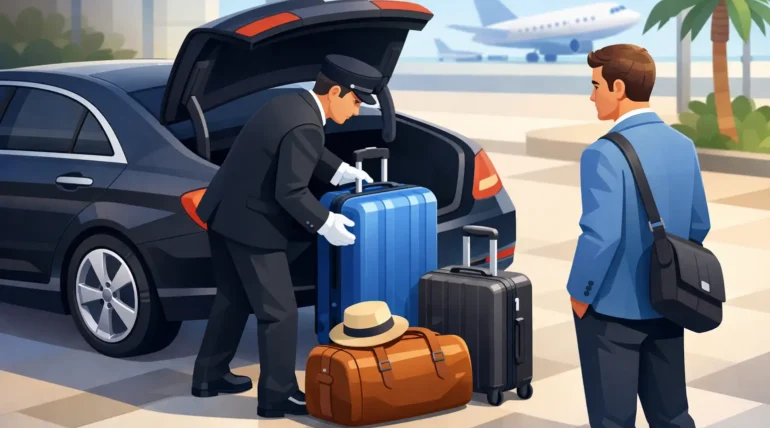
A curbside arrival should not begin with you wrestling a suitcase out of a trunk while traffic moves behind you. So, do chauffeurs handle luggage? With a professional private car service, the answer is generally yes. Assisting with luggage is a standard part of door-to-door chauffeur service, whether you are arriving at Salt Lake City International Airport, leaving a downtown hotel, or traveling to a mountain resort with ski bags in tow.
That assistance is more than a courtesy. It is part of the operational detail that separates a chauffeured transfer from simply reserving a vehicle. Your chauffeur should be prepared to load and unload your bags carefully, confirm that nothing has been left behind, and help make the transition from terminal to vehicle or vehicle to hotel as direct as possible.
What Luggage Assistance Typically Includes
For most scheduled airport transfers and private rides, a chauffeur will meet you at the appropriate pickup point, greet you, and take responsibility for placing your luggage in the vehicle. At your destination, they will remove your bags and place them where practical – at the hotel entrance, private residence, office lobby, or designated drop-off area.
This usually covers typical checked luggage, carry-ons, garment bags, briefcases, strollers, and personal items that fit safely in the vehicle. The chauffeur will also arrange bags to protect the cabin, preserve passenger comfort, and keep necessary items accessible during the ride.
For an airport arrival, the exact handoff depends on the service selected and airport procedures. Some passengers meet their chauffeur outside after collecting bags, while others arrange a more formal meet-and-greet. In either case, a well-coordinated pickup includes clear arrival instructions and flight monitoring, so the vehicle timing reflects your actual arrival rather than the original schedule alone.
Do Chauffeurs Handle Luggage at Hotels and Residences?
Yes. Chauffeurs commonly assist at both ends of a ride, not just at the airport. At a hotel, this may mean unloading bags at the main entrance and coordinating respectfully with the bell staff. At a private residence or vacation rental, it often means bringing bags to the entrance or another accessible, requested location.
There are sensible limits. A chauffeur may not be able to take items through a property, upstairs, or into a room, particularly when building rules, security requirements, or the size and weight of an item create a safety concern. Hotel bell teams may also have their own procedures for taking luggage beyond the lobby. The goal is professional assistance without disrupting the property’s operation or compromising safety.
For travelers with limited mobility, young children, or a demanding itinerary, it is wise to mention any extra help needed when booking. That gives the transportation provider an opportunity to plan the right vehicle, timing, and level of support.
Airport Transfers Require More Than a Large Trunk
Luggage handling is especially valuable after a long flight, but capacity must be planned in advance. A luxury sedan may be ideal for one or two travelers with standard bags. A luxury SUV can offer more space and all-wheel-drive capability for a mountain route. Larger families, corporate groups, and wedding parties may be better served by a Sprinter van or another vehicle designed for both passengers and luggage.
The number of passengers is only half the calculation. Four adults traveling for a weekend may fit comfortably in an SUV. Four skiers arriving for a week with large suitcases, boot bags, and ski equipment may require a larger configuration. A precise reservation asks about both passenger count and luggage because an immaculate vehicle is only useful when everyone and everything fits safely.
Professional chauffeurs do not simply force bags into available space. They consider visibility, vehicle balance, passenger room, and the need to secure items during the trip. This matters on the route from Salt Lake City to Park City, Deer Valley, Alta, Snowbird, Brighton, or Solitude, where mountain weather and winding roads call for careful driving and properly stowed cargo.
Ski Bags, Snowboards, and Oversized Equipment
Ski and snowboard travelers should never assume their equipment will fit based on a vehicle photo alone. Bag length, hard cases, the number of passengers, and whether travelers also have large checked luggage all affect vehicle selection.
Share the details before your reservation is finalized: the number of ski or snowboard bags, whether equipment is in a hard case, the number of standard suitcases, and any oversized items such as a stroller, golf clubs, or mobility equipment. This is not unnecessary formality. It allows the dispatch team to assign a vehicle with the appropriate cargo arrangement rather than making last-minute compromises at the curb.
If you are bringing skis, ask whether the vehicle can accommodate them inside or requires a specific equipment setup. Equipment should be protected from the elements and secured in a way that does not crowd passengers or obstruct the driver.
When to Give Advance Notice
Standard luggage rarely requires special instruction. Advance notice becomes essential when your group has an unusually high volume of bags, oversized pieces, or items that need particular handling. It is also helpful to notify your provider if you are traveling with child seats, a folding wheelchair, medical equipment, presentation materials, or delicate items.
A few details can prevent avoidable delays:
- Your total number of passengers, including children
- The number of checked bags, carry-ons, and large personal items
- Ski bags, snowboard bags, hard cases, or other oversized equipment
- Any need for a child seat or additional assistance at pickup
Accurate information protects the quality of the transfer. It also helps preserve the benefits travelers expect from private service: room to relax, a clean and orderly cabin, and a departure that stays on schedule.
What Chauffeurs Usually Cannot Handle
Professional luggage assistance has practical boundaries. Chauffeurs should not be expected to lift items that are unsafe because of their weight, shape, or condition. They may decline to handle leaking, hazardous, or improperly packed items. Airlines and airports also maintain rules around restricted materials, and a ground transportation provider cannot override those requirements.
Valuables deserve special attention as well. Keep passports, medications, jewelry, cash, laptops, and essential documents with you rather than placing them in the trunk. A chauffeur can help with the physical movement of bags, but travelers should remain responsible for confirming they have their most important personal items before leaving the pickup area.
It is also good practice to do a quick check before the vehicle departs. Look at the terminal curb, hotel lobby, baggage cart, and vehicle floor before settling in. At drop-off, confirm that every bag has been removed before the chauffeur leaves. This takes less than a minute and is particularly useful for families and groups whose belongings may be split across several pieces of luggage.
The Difference Is in the Details
Luggage assistance may sound like a small feature, yet it shapes the first and last minutes of a trip. After a delayed flight, a child’s ski race, or a full day of meetings, travelers should not have to negotiate cargo space or wonder whether their bags will be handled with care.
At MIB Limousine, that expectation is built into a private transfer experience designed around punctual arrivals, appropriate vehicle selection, and disciplined pickup coordination. Real-time flight tracking and upfront planning help ensure the chauffeur is ready when you are, while the right vehicle helps keep luggage, equipment, and passengers comfortable on the road.
When reserving your next ride, provide an honest picture of what you are bringing. A chauffeur can handle the luggage with confidence when the service has been given the information to prepare properly – leaving you free to focus on the trip ahead.