


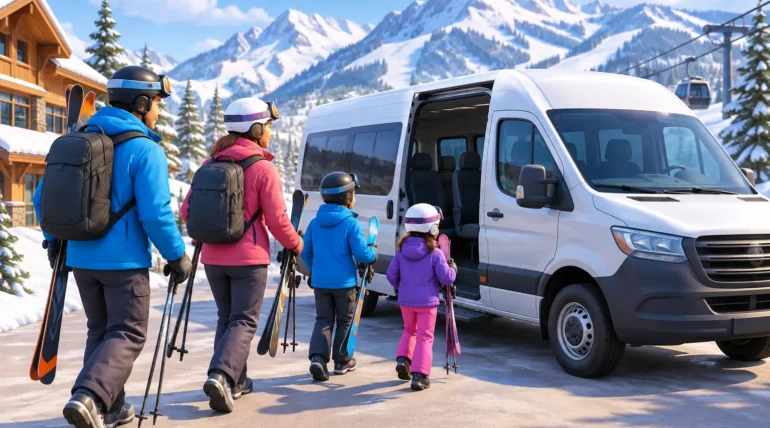
A ski group transfer example is most useful when it reflects the details that actually shape an arrival day: a delayed flight, multiple ski bags, tired children, a large amount of luggage, and a mountain forecast that changes by the hour. For a family or private group traveling from Salt Lake City International Airport to a Utah resort, the right transfer plan begins well before the aircraft lands.
Consider this realistic scenario: eight travelers arrive at SLC on a Saturday afternoon in February. The party includes six adults and two children, with eight checked suitcases, four ski bags, two boot bags, and carry-on luggage. Their destination is a private residence in Deer Valley, and the group has requested two child seats. They want to travel together, avoid waiting in a public transportation queue, and arrive with enough time to settle in before dinner.
For this group, transportation is not simply a ride from the airport. It is the first operational step of the vacation.
The ski group transfer example: SLC to Deer Valley
The travelers book a private luxury Sprinter van rather than two separate SUVs. A single vehicle keeps the group together, gives the chauffeur one complete arrival plan to manage, and provides dedicated room for skis, snowboards, luggage, and personal items. For larger groups, that shared space can be more comfortable than dividing people and equipment between multiple vehicles.
The reservation is scheduled using the arriving flight number, not just a requested pickup time. Real-time flight tracking allows the chauffeur team to monitor early arrivals, delays, gate changes, and the practical timing of the passenger exit. Airport coordination is based on when the group is ready to meet, not on an assumption that everyone will be outside at a fixed minute.
After landing, the travelers collect their luggage and send a quick confirmation that the entire party is together. Their chauffeur meets them at the designated airport location, assists with loading, confirms the resort address, and secures the child seats before departure. Bottled water and charging access are small details, but they matter after a long flight and before a mountain drive.
In normal traffic and dry conditions, the drive from Salt Lake City International Airport to Deer Valley often takes about 45 to 60 minutes. On a busy ski weekend, during a storm, or when canyon traffic is restricted, it can take longer. A professional transfer plan leaves room for that reality instead of promising an unrealistic arrival time.
Why one vehicle is not always the right answer
A luxury Sprinter is an excellent fit for this eight-person example, but vehicle selection should be based on the complete travel profile, not guest count alone. Eight passengers traveling with only carry-on bags may have different needs than six guests traveling with ski bags, oversized luggage, and a week of winter clothing.
A premium all-wheel-drive SUV can be ideal for a family of four to six, depending on equipment volume. It provides a private, refined experience and performs confidently on mountain routes. For a group of seven to 10, a Sprinter usually provides more comfortable passenger space and better capacity for luggage. A larger party may be best served by multiple coordinated vehicles, particularly if the group has extensive equipment or arrives on different flights.
The key trade-off is simple. One larger vehicle gives the group a shared experience and one arrival point. Multiple vehicles can offer more flexibility, especially when travelers have separate destinations, special luggage needs, or different flight schedules. An experienced transportation provider will ask about both passenger count and equipment before confirming the right option.
Equipment capacity deserves a direct conversation
“Ski gear” can mean very different things. A compact ski bag for two pairs of skis takes less room than individual hard cases. Snowboards, boot bags, strollers, golf clubs carried for a later stop, and large duffels all affect loading capacity.
The best practice is to share an accurate equipment list when reserving. Include the number of ski or snowboard bags, checked bags, carry-ons, child seats, and any unusually large items. This allows the vehicle assignment to be made with confidence, rather than forcing last-minute adjustments outside the terminal.
The arrival timeline that protects the first day
For this example, the group’s flight is due into SLC at 2:20 p.m. They have a 6:30 p.m. dinner reservation near their Deer Valley lodging. That seems generous on paper, but the plan accounts for airport walking time, baggage claim, restroom breaks, child-seat installation, winter traffic, and a possible grocery stop.
The group is expected to be ready for pickup approximately 35 to 50 minutes after landing. If checked luggage is delayed or the flight arrives late, the chauffeur team adjusts based on the actual arrival status. The guests do not need to guess whether their car has left or whether a fixed-rate reservation has been affected by the delay.
Once loaded, the chauffeur confirms the preferred route and any planned stop. If weather is moving into Parleys Canyon, the driver may recommend leaving the airport promptly and handling nonessential errands after check-in. If the roads are clear and the group needs groceries, a brief stop can be built into the itinerary in advance. The right choice depends on conditions, time of day, and the group’s priorities.
That flexibility is particularly valuable for ski travelers. A storm day can create slow canyon movement but also make an early arrival at the resort more desirable. A clear afternoon may make a stop practical. The transfer should be managed as a live operation, not treated as a generic airport ride.
Weather readiness is part of premium service
Mountain travel in northern Utah requires more than a polished vehicle. It requires drivers who understand winter routes, resort access roads, traffic patterns, and the difference between a forecast and the road conditions actually developing that afternoon.
For the Deer Valley example, the vehicle is inspected before dispatch, equipped appropriately for the season, and driven by a professional chauffeur familiar with the route. All-wheel drive supports confident travel in changing conditions, but it does not replace measured driving, route awareness, and realistic timing.
This is also why fixed, upfront pricing matters. Ski weekends, holidays, and storms are the exact times travelers need dependable transportation most. A private transfer should not become an uncertain expense because demand rises or weather deteriorates. Confirmed pricing lets the group plan confidently before departure.
How the plan changes for other Utah resorts
The same approach applies across the Salt Lake City and Park City resort corridor, but the details should change with the destination. A transfer to Park City or Canyons Village may follow a different timing pattern than a trip to Alta, Snowbird, Brighton, or Solitude. Canyon restrictions, snowfall, arrival hour, and the location of the lodging all influence the most practical plan.
For Alta and Snowbird, weather planning can be especially important because Little Cottonwood Canyon conditions may affect travel time. For Brighton and Solitude, equipment capacity and family timing still matter, while the preferred route may differ. For Park City and Deer Valley, weekend traffic and the final neighborhood or slope-side access point can determine whether a transfer needs extra time.
A precise reservation includes the resort, hotel or residence name, flight details, passenger count, equipment list, child-seat requirements, and any requested stop. That information turns a basic transportation booking into an organized arrival plan.
What this group experiences at the destination
In this example, the party arrives at its Deer Valley residence with the entire group, luggage, skis, and children accounted for in one coordinated transfer. The chauffeur assists with unloading and ensures the guests are at the correct entrance before departing. There is no parking search, no rental-car counter, no need for a designated winter driver, and no attempt to fit ski bags into a vehicle that was not selected for them.
The group’s first hours in Utah stay focused on checking in, getting comfortable, and looking ahead to the next morning on the mountain. That is the practical value of private airport transportation: fewer moving pieces when the stakes are highest.
MIB Limousine plans ski group transfers around real passenger needs, from flight monitoring and equipment space to professionally managed mountain travel. When every traveler and every bag has a place before the flight departs, the arrival day feels appropriately calm – even when the weather is not.